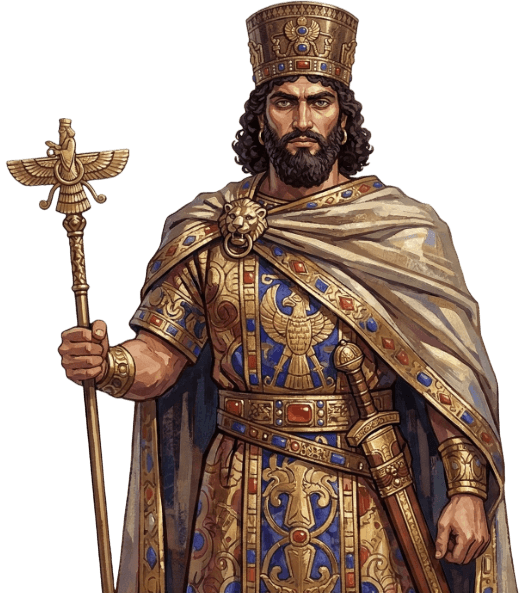
Arame
The Founder
Araratian Dynasty — ~860–844 BC
Kingdom of Urartu
Arame reigned from 859 to 840 BC as the foundational monarch of the Kingdom of Ararat (Van) and was the first ruler to successfully unify the Armenian Highlands into a centralized state. Emerging from the heartland of Ayrarat, he consolidated the various Nairi tribes and highland clans to resist the expansion of the Neo-Assyrian Empire. His primary royal centers included the fortress of Sugunia and the capital city of Arzashkun. His reign was defined by a strategic defense against the Assyrian King Shalmaneser III. Although his capitals suffered destruction during these massive invasions, Arame’s ability to preserve the core of his kingdom and maintain its military-political power laid the essential groundwork for the future empire. In Armenian historiography, he is famously identified by Moses Khorenatsi as Aram the Haykian, representing the transition of the Armenian people into organized statehood.
In the early 9th century BC, while the surrounding regions of the Near East were being swallowed by the Assyrian war machine, a transformative leader emerged in the central highlands of Ayrarat. Arame reigned between 859 and 840 BC, recognizing that the survival of the highland tribes depended on unity rather than fragmentation. By forging the disparate Nairi clans into a singular political and economic entity, he created the Kingdom of Ararat (Urartu)—a state capable of challenging the greatest empires of the ancient world.
The Great Shield Against Assyria
The sovereignty of the Armenian Highlands was immediately tested by the relentless campaigns of the Assyrian King Shalmaneser III. Historical records, including the famous bronze reliefs of the Balawat Gates now held in the British Museum, depict the ferocity of these conflicts. In 859 BC, the Assyrians captured the border fortress of Sugunia, and by 857 BC, they reached the royal capital of Arzashkun. Though Shalmaneser claimed to have "crushed the land like a wild bull," Arame proved to be a master of resilient warfare. He utilized the rugged terrain of the Adduro Mountains to preserve his forces, forcing the Assyrians to eventually retreat and proving that the Highland Kingdom could not be easily conquered.
The Legacy of the First King
The era of Arame’s leadership marked the beginning of the Armenian political tradition in the region of Biainili (Van). By the year 845 BC, even his enemies acknowledged his status, with Assyrian inscriptions formally recognizing him as the King of Urartu. His efforts expanded the borders of the kingdom to the north and west, securing the Euphrates sources and stabilizing the Armenian plateau. As chronicled by the father of Armenian history, Moses Khorenatsi, Arame remains the symbolic father of Armenian sovereignty—the king who first asserted the right of the highland people to rule themselves.
Royal Record
Family & Notes
Wives: Epige, Arkana. x x x x First attested ruler. Defended against Shalmaneser III.
Wars & Battles
1 recorded war (Assyrian invasion).
War Record
0 Won, 1 Lost.
Territory Size
150,000–200,000 km². Armenian Highlands
“The legacy of Arame the Founder serves as the cornerstone of the Armenian nation—a reminder that in the face of overwhelming shadows, unity and the mountain spirit are the ultimate guardians of a people’s destiny.”
Continue the Journey