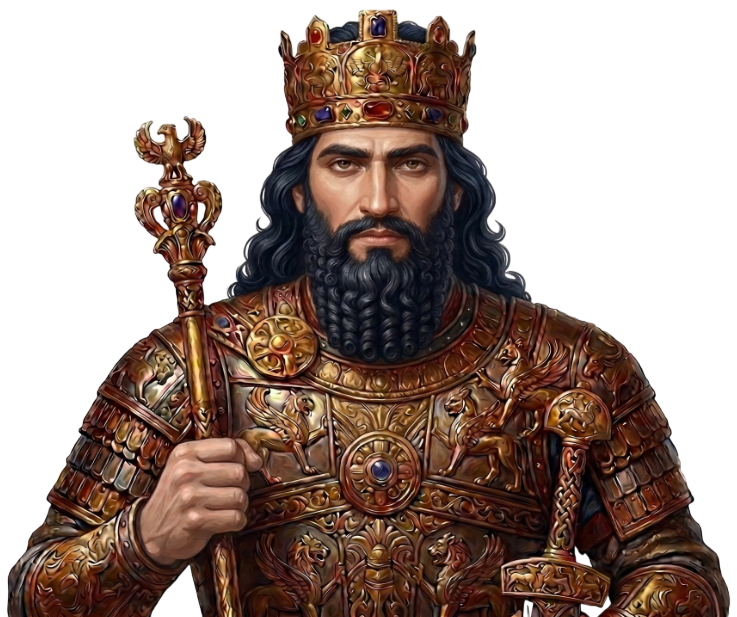
Argishti II
Araratian Dynasty — 714–685 BC
Kingdom of Urartu
Argishti II reigned from 714 to 685 BC as the monarch of the Kingdom of Ararat (Urartu), succeeding his father, Rusa I. His reign was defined by the systematic restoration of the state following the destructive Assyrian invasion of 714 BC. He strengthened the central authority, rebuilt the national army, and pushed the kingdom's eastern borders to the Caspian Sea, as evidenced by his inscriptions found near the city of Artavet (Ardabil). Beyond his military role, Argishti II was a dedicated builder who established a new city, an artificial lake, and a canal system in the region of Arjesh (Vaspurakan). His foreign policy was characterized by powerful counter-offensives against the Assyrian Empire under King Senekerim (Sennacherib). Argishti II's forces successfully reconquered major towns around Lake Urmia, including Musashir (Ardni), and pushed as far south as the city of Nimrud on the Tigris River. This period of military success and civil development initiated a "Golden Age" of prosperity for the highlands. He was also a patron of culture who organized and personally participated in royal athletic games.
Following the devastation left by Sargon II, Argishti II reigned between 714 and 685 BC, leading a transformative era of recovery for the Kingdom of Ararat (Urartu). He focused his early efforts on consolidating the central government and neutralizing the effects of previous invasions. His success in stabilizing the realm allowed for an unprecedented eastward expansion; inscriptions preserved on the slopes of Savalan Mountain confirm that Urartian influence reached as far as the Caspian Sea during this time. This period of stability and economic growth is often remembered as a "Golden Age" that provided a prosperous foundation for his successors.
The Counter-Offensives Against Assyria
The military career of Argishti II was marked by a strategic shift from defense to aggressive counter-strikes against the Assyrian heartland. When King Senekerim (Sennacherib) launched campaigns against the highlands, Argishti II responded with massive offensives that drove the Assyrian forces back across their pre-war borders. His armies reconquered essential territories such as Musashir (Ardni), Ushnu, and Tepe, eventually seizing control of lands as far south as the Tigris River. These victories forced the Assyrian Empire to accept a lengthy peace and cede large tracts of territory. His authority was so respected that in 681 BC, he provided a safe haven for Senekerim’s sons, Adramelik and Sharasharan (Sanasar), after they fled their own country.
Infrastructure and Cultural Life
In addition to his martial achievements, Argishti II was a prolific builder of civil works. In the region of Arjesh (Vaspurakan), he left records of the construction of a new city, an artificial lake, and an irrigation canal, demonstrating his commitment to the kingdom's economic infrastructure. He was also deeply involved in the social traditions of the state, organizing large-scale athletic games. Historical records highlight that the king did not merely preside over these events but was an active participant in the competitions. Through this combination of military dominance, engineering, and cultural patronage, Argishti II restored the sovereignty and prestige of the Armenian Highlands.
Royal Record
Family & Notes
Father: Rusa I. Son: Rusa II. Maintained defensive posture against northern nomads. - He did not merely maintain a "defensive posture." Inscriptions show he conducted campaigns to the east, attempting to restore Urartian influence after his father's defeats. Credit: His own inscriptions from Armavir and other sites.
Wars & Battles
0 recorded in primary sources. Several unrecorded vs. Cimmerians/Scythians.
War Record
- Mixed/Draws.
Territory Size
Diminished territory ~300,000 km²
“The legacy of Argishti II endures through the centuries — a testament to the enduring spirit of the Armenian people and their unbroken pursuit of sovereignty, culture, and faith.”
Continue the Journey