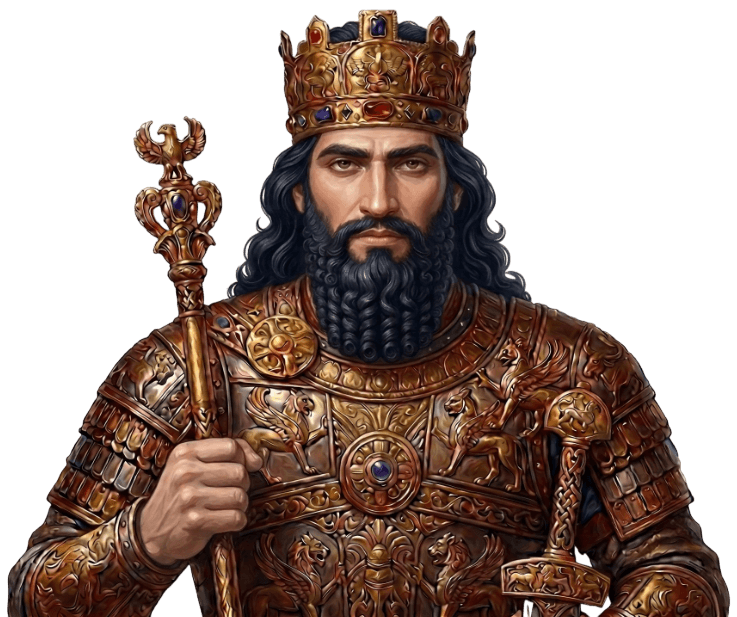
Rusa II
Araratian Dynasty — 685–639 BC
Kingdom of Urartu
Rusa II reigned from 685 to 645 BC, though some records extend his rule until 639 BC, as the last most prominent monarch of the Kingdom of Ararat (Urartu). The son and successor of Argishti II, he bore the titles of "Great King," "King of the Universe," and "King of Biainili." His reign was characterized by a massive resurgence in both domestic infrastructure and active foreign diplomacy. He is historically renowned for founding several major cities and fortresses, most notably Teishebaini (Karmir-Blur) in the Aza country, which became the new administrative and military heart of the northern provinces, surpassing the older centers of Erebuni and Argishtihinili. In addition to his vast construction projects, Rusa II navigated a complex geopolitical landscape through strategic alliances with the Cimmerians and Sakai tribes. He maintained a notable period of peaceful coexistence and mutual assistance with the Assyrian King Esarhaddon, while later sending friendly embassies to Ashurbanipal. His engineering legacy remains visible through the "Umeshe" canal, which he cut from the Ildaruni (Hrazdan) River to irrigate the vast Dalma Gardens, transforming barren lands into vineyards and forests.
Rusa II reigned between 685 and 645 BC, focusing his military efforts on the western and northwestern frontiers. He successfully conquered the lands of Taplani and the Mushki(ni) country along the southern banks of the Aratsani River. Pushing beyond the Euphrates, he established dominance over the lands of Hatti, Halitu, and Lubaraxi, areas where Assyrian ambitions were often thwarted. Despite the historical rivalry with Assyria, Rusa II established a pragmatic relationship with King Esarhaddon, characterized by mutual neutrality and even cooperation. In 673 BC, after a victory in Shupria, Esarhaddon returned Urartian refugees and slaves to Rusa II—a rare act of diplomatic goodwill between the two powers who shared a common interest in stabilizing their borderlands.
The Golden Age of Construction
The reign of Rusa II is considered the final great era of architectural and economic development for the Kingdom of Ararat (Biainili). He founded the monumental fortress complex of Teishebaini (Karmir-Blur), which served as a vital strategic shield for the northern heartland. His building program extended across the highlands, including the construction of Rusahinili (Toprakkale) near Van, the "Small City of Rusa" in the Maku region, and a city dedicated to the god Khaldi on the northwest shore of Lake Van. To support these new urban centers, Rusa II developed sophisticated irrigation networks. One of his most famous projects involved a canal drawn from the Ildaruni (Hrazdan) River to the plains of Kuarlini, creating the historic Dalma vineyards that flourished for centuries.
Legacy of the King and the Fall of Teishebaini
In Armenian tradition, Rusa II is often paralleled with the legendary figure Anushavan Sosanver, a ruler described by Moses Khorenatsi as "powerful in deed and a genius in word." This connection stems from Rusa II’s dedication to sacred forests and his role as a high-authority monarch. However, the splendor of his reign eventually faded as the kingdom weakened under his successors. Approximately in 590 BC, the central capital of Tushpa (Van) and the northern hub of Teishebaini both fell to the combined forces of the Medes and Scythians. Though the city was destroyed in a night-time assault, the cuneiform inscriptions of Rusa II remain as a testament to his vision of a prosperous and fortified empire.
Royal Record
Family & Notes
Father: Argishti II. Wife: Koton. His wife's name "Koton" is recorded on a cuneiform tablet from Karmir-Blur (Teishebaini). The Assyrian recognition as "Yaya" is noted in Assyrian correspondence. Credit: Boris Piotrovsky, The Ancient Civilization of Urartu (1969).
Wars & Battles
1 recorded war (Cimmerians).
War Record
Mixed results.
Territory Size
Consolidating~300,000 km²
Allied Rulers
Diplomatic friendship/recognition by Assyria as "Yaya".
“Argishti’s son Rusa says: Whoever destroys this inscription, whoever breaks it, buries it in the earth, or throws it into the water—may the gods Khalde, Teisheba, and Shivine not spare him, and may they leave neither his name nor his seed upon the earth.”
Continue the Journey