Arsaces II
Arsacid Dynasty — 350–368 AD
Arsacid Dynasty
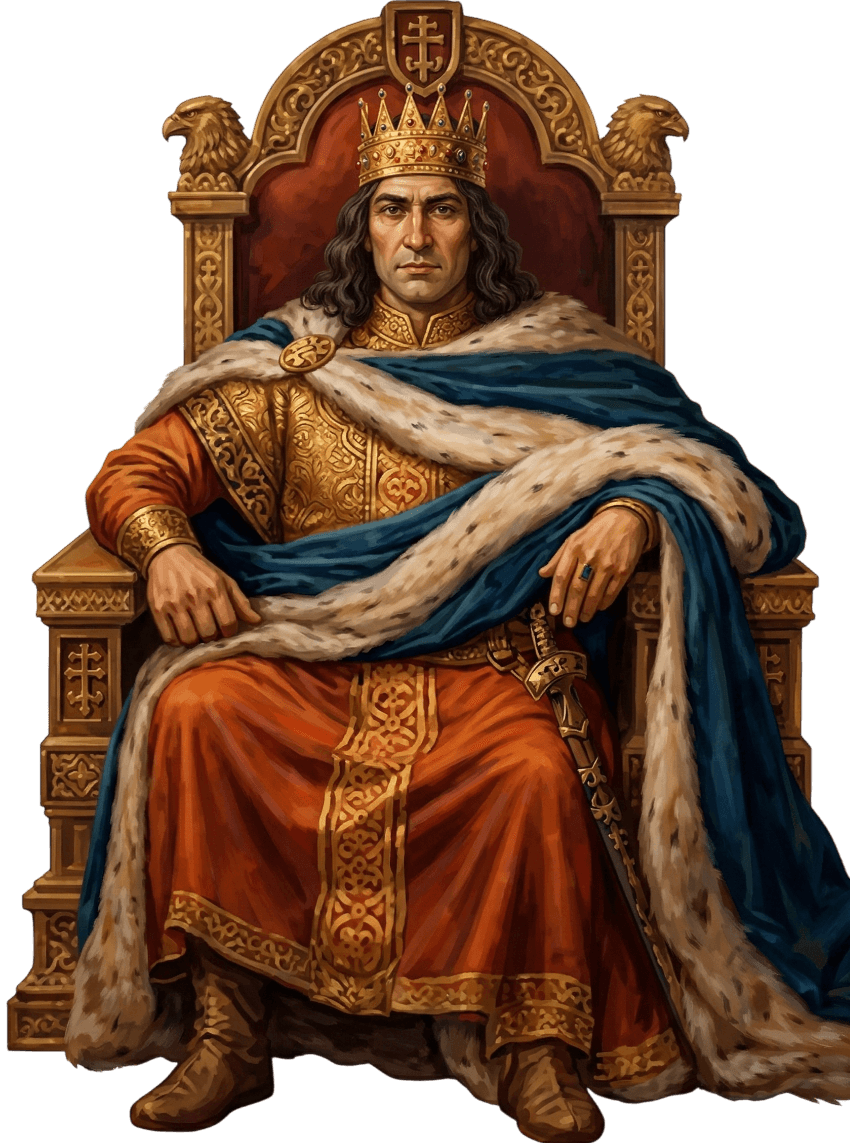
Arshak II reigned from 350 to 368 AD as the monarch of the Kingdom of Armina (Greater Armenia), succeeding his father, Tiran II. His ascension was secured through a joint Armeno-Roman victory at the Battle of Voskha, which forced the Sasanian King Shapur II to release his father from captivity. Despite the pressures of the surrounding empires, Arshak II maintained a fiercely independent policy, balancing relations between the Romans and Sasanians while reorganizing the Armenian military with a focus on heavy armored cavalry. His domestic reign was marked by a constant struggle to centralize royal power against the influential noble houses and the Armenian Church. He is most historically distinguished for founding the city of Arshakavan (Kogovit), designed as a tax-free haven for the common people to weaken the feudal lords. His rule ended in tragedy after Rome abandoned Armenia in the "Shameful Peace" of 363 AD, leaving him to face the Sasanians alone. Lured to Tizbon (Ctesiphon) under a false oath of safety, he was imprisoned in the Castle of Oblivion, where he ultimately died.
Arshak II reigned between 350 and 368 AD, taking the throne during an era of temporary peace between Rome and Persia. Utilizing this stability, he worked to consolidate the fractured feudal regions of the Kingdom of Armina (Greater Armenia). He reconciled with disgruntled noble families, such as the Mamikonians, appointing Vasak Mamikonian as his sparapet. His early reign also saw significant religious developments; in 353 AD, Catholicos Nerses the Great convened the first Armenian Church Council at Ashtishat (Taron), which established strict laws against pagan customs and founded the kingdom's first hospitals and schools. However, this period of cooperation soon shifted toward intense friction as Arshak II sought to limit the territorial wealth of the Church and the nobility.
The Vision and Tragedy of Arshakavan
The centerpiece of Arshak II’s internal policy was the founding of the city of Arshakavan in the province of Kogovit. To build a loyal base of subjects and bypass the control of the nakharars (nobles), the king issued a decree granting asylum and tax-exempt status to anyone who moved to the city, including debtors and outcasts. This triggered a mass migration of thousands of peasants seeking to escape feudal exploitation. Outraged by this loss of labor and power, the Armenian nobility, led by Meruzhan Artsruni and supported by Sasanian troops, launched a brutal attack on the city while Arshak was away in Virk (Iberia). The resulting massacre saw nearly 40,000 inhabitants slaughtered and the city reduced to ruins, an event that forced the king into a bloody retaliation against the rebel houses.
The Shameful Peace and the Castle of Oblivion
The final years of Arshak II's reign were defined by the resurgence of the Roman-Persian wars. In 360 AD, Arshak II reaffirmed his loyalty to the Roman Emperor Constantius II, but the situation turned dire following the death of Emperor Julian and the rise of Jovian. In 363 AD, the Romans signed the "Shameful Peace," officially abandoning their Armenian allies to the Sasanians. Left to fight alone, Arshak II and Vasak Mamikonian waged a four-year defensive war against Shapur II’s superior forces. Seeking an end to the conflict, Shapur II lured the king and his general to Tizbon (Ctesiphon) with a sacred oath of safety. Upon their arrival, the king was betrayed, arrested, and cast into the infamous Castle of Oblivion in Khuzistan, where he spent his final days in captivity.
Royal Record
Family & Notes
Wife: Pharandzem. Child: Pap. Notes: Imprisoned in the "Castle of Oblivion" in Persia where he died. His wife led the defense of Artogerassa.
Wars & Battles
5 Battles: 1. Persian War (350-363); 2. Battle of Samarra; 3. Siege of Artogerassa; 4. Civil War; 5. Capture by Shapur II.
War Record
2 Won, 2 Lost, 1 Draw
Territory Size
c. 350,000 km2km^2km2
Allied Rulers
Julian (Rome)
“The legacy of Arsaces II endures through the centuries — a testament to the enduring spirit of the Armenian people and their unbroken pursuit of sovereignty, culture, and faith.”
Continue the Journey