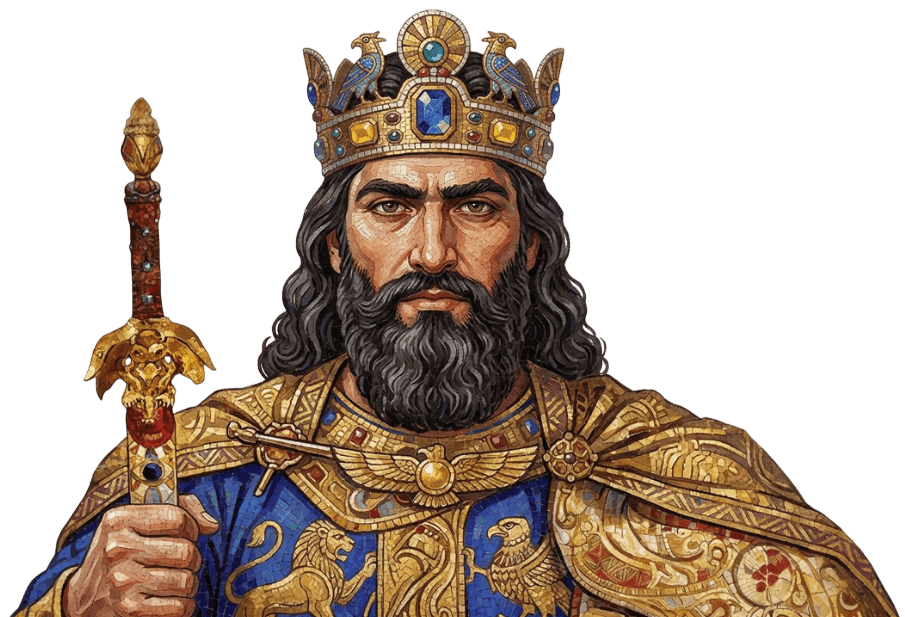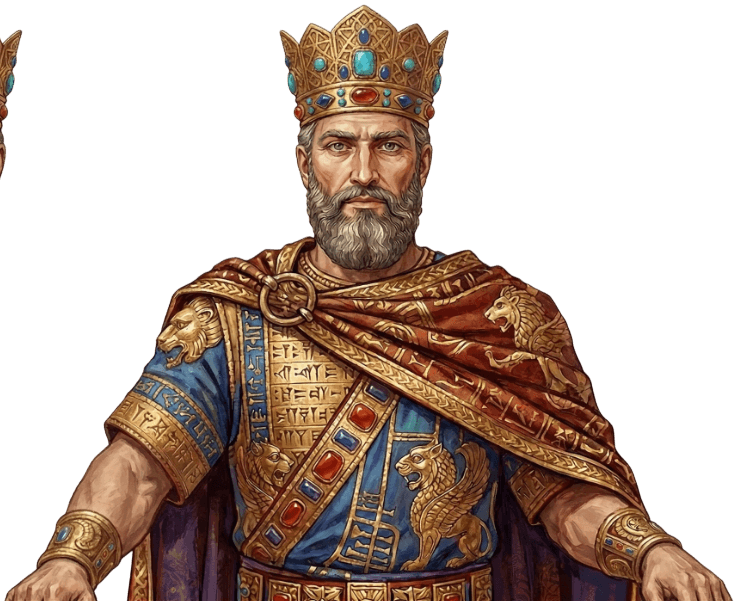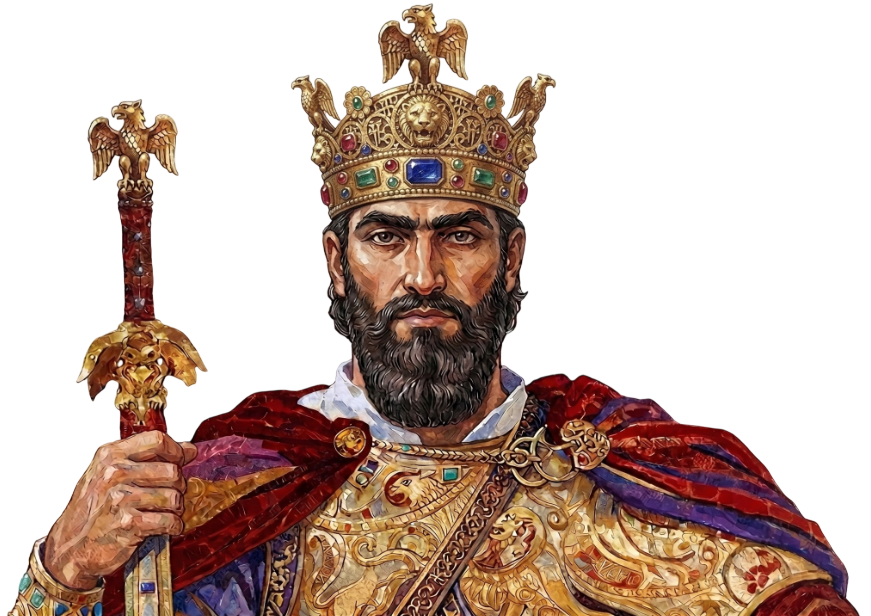
Ishpuini
Araratian Dynasty — 828–810 BC
Kingdom of Urartu
Ishpuini reigned from 828 to 810 BC as the King of the Kingdom of Ararat (Urartu). The son of Sarduri I, he performed a vital service to history by adapting Assyrian cuneiform to the Urartian language, despite the phonetic difficulties of the local tongue. His reign was marked by the strengthening of the state’s defense through the construction of numerous fortresses in Tushpa (Van) and along the Upper Aratsani. Beyond construction, he initiated fundamental reforms, including the transition from a federal militia to a professional regular army and the establishment of a unified religious pantheon for the kingdom. Ishpuini’s military leadership saw the kingdom expand significantly to the north and south. In 824 BC, his forces defeated a coalition of northern principalities near Alashkert, and in 822 BC, he achieved a major victory against the Assyrian King Shamshi-Adad V in Aghdznik (Alshe). These successes allowed him to incorporate Ardni-Musasir (Ardini) and extend his influence into Parsk (Western Persia). In his later years, he shared the throne with his son Menua, eventually dedicating himself to the high priesthood after securing the titles of "Great King" and "King of the Universe."
Ishpuini reigned between 828 and 810 BC, focusing his early years on the internal strengthening of the Kingdom of Ararat (Urartu). He was the first monarch to adapt Assyrian cuneiform for the Urartian language, a challenging task due to the complex phonetics of the native speech. This cultural breakthrough allowed for the recording of the kingdom's history and official decrees. Furthermore, he replaced the previous system of federal militias with a professional regular army, a move that greatly increased the military power of the state and allowed it to challenge neighboring empires on more equal footing.
The Wars for Sovereignty
The military career of Ishpuini was defined by his resistance against the Assyrian King Shamshi-Adad V and the unification of the Armenian Highlands. In 824 BC, at the Battle of Alashkert, the Araratians defeated the combined armies of Tayk, Gugark, Khalktik, and Artsakh. While the Assyrians initially raided Aghdznik (Alshe) and Korchayk (Corduene) in 823 BC, Ishpuini led a counter-offensive in 822 BC. Utilizing an attack from the rear by the Prince of Aghdznik, Ishpuini’s army of 60,000 defeated the 70,000-strong Assyrian force. Following this success, he captured Ardni and southeast Korchayk, asserting dominance over Parsk (Western Persia). To commemorate these victories, he ordered the planting of plane tree forests and the construction of new temples.
Religious Unity and Co-regency
In the second half of his reign, Ishpuini ruled alongside his son and successor, Menua. Together, they implemented a major religious reform by creating a unified pantheon for the kingdom, combining the deities of the former Nairi confederation. This hierarchy of gods was inscribed on the rock known as the "Khaldi Gate," which later became known as Meher's Door (Van). Ishpuini also integrated Ardni-Musasir (Ardini) into the kingdom, making it a primary spiritual center. Holding titles such as "Powerful King," "King of the Universe," and "King of the Nairi, Sura, and Biaina Lands," Ishpuini spent his final years as a high priest, leaving behind a stable and expansive empire for his son.
Royal Record
Family & Notes
Father: Sarduri I. Wife: Naira(unattested) Son: Menua. Introduced a centralized administrative structure.
Wars & Battles
1 recorded war (Conquest of Musasir).
War Record
1 Won, 0 Lost.
Territory Size
Expanded to Musasir ~250,000 km²
“The legacy of Ishpuini endures through the centuries — a testament to the enduring spirit of the Armenian people and their unbroken pursuit of sovereignty, culture, and faith.”
Continue the Journey