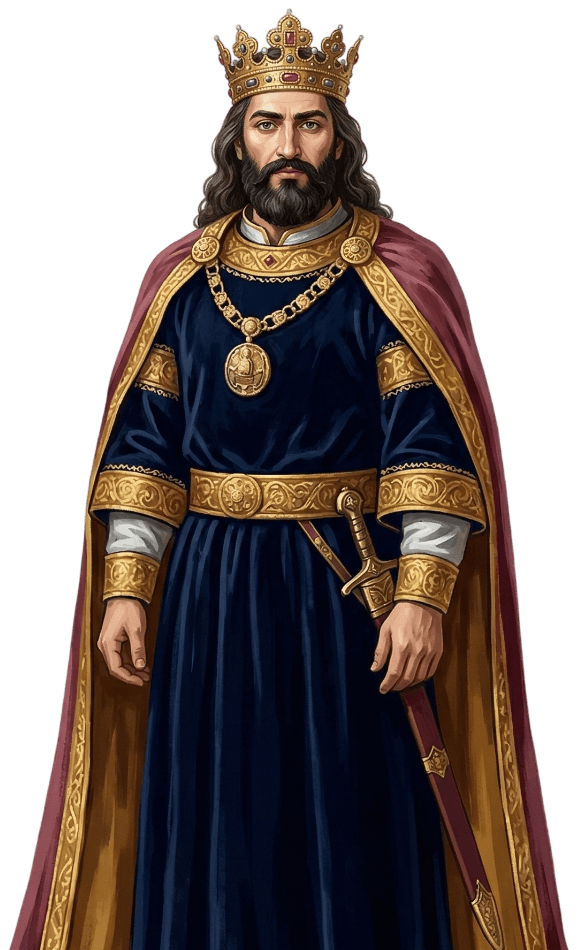
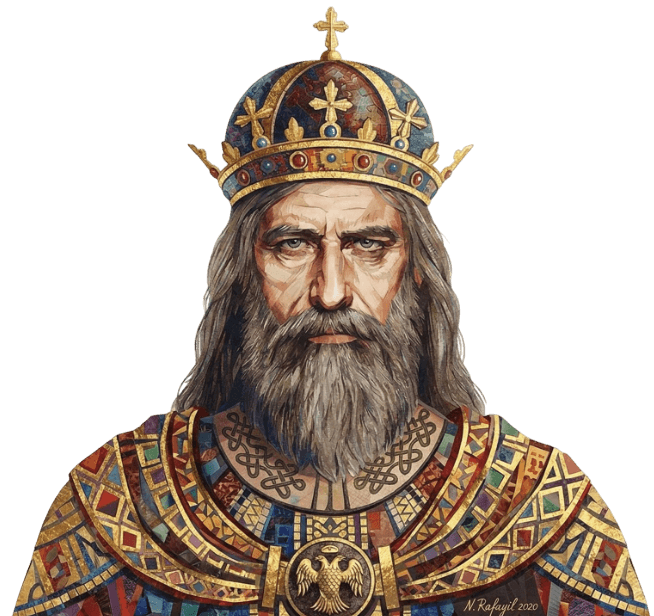
Khosrov III
Kotak
Arsacid Dynasty — 330-338 AD
Arsacid Dynasty
Khosrov III reigned from 330 to 338 AD as the monarch of the Kingdom of Armina (Greater Armenia), succeeding his father, Tiridates III. Despite his short stature—for which he received the epithet "Kotak"—he proved to be a decisive ruler who successfully navigated a period of deep internal chaos and rebellion. With the support of the Roman Emperor Constantine the Great and Patriarch Vrtanes, he suppressed revolts by the bdeashkh Bakur and the pretender Sanatruk, beheading the latter after the Battle of Oshakan. His reign is historically significant for the relocation of the Armenian royal court from Vagharsapat to his newly founded capital city, Dvin. He is also renowned for establishing the royal hunting grounds and forest reserves of Khosrovakert and Tachar Mayri, known today as the Khosrov Forest. Khosrov III worked to centralize the monarchy by decreeing that all powerful lords with over 1,000 soldiers must reside at the royal court, ensuring his control over the nobility until his death in 339 AD.
Khosrov III reigned between 330 and 338 AD, ascending the throne during a time of fragmentation following the death of Tiridates III. He immediately faced two major uprisings: one by the northern prince Sanatruk (Sanesan), who seized Vagharsapat (Echmiadzin), and another by Bakur of Arzanene in the southwest, supported by the Sasanian King Shapur II. To stabilize the realm, Khosrov III launched aggressive military campaigns led by his sparapet Vache Mamikonian and Vahan Amatuni. These forces successfully crushed the separatist movements and exterminated the feuding noble houses of the Orduni and Manavazian clans, whose lands were subsequently seized by the crown to ensure internal peace and territorial integrity.
The Founding of Dvin and the Royal Forests
A hallmark of Khosrov III's domestic policy was his ambitious urban and environmental projects. Due to environmental changes and the need for a more defensible center, he moved the kingdom's capital to the newly established city of Dvin. Beyond administrative construction, he dedicated significant resources to the creation of the Khosrovakert and Tachar Mayri reserves. These expansive forests were not only intended for royal recreation and hunting but served as essential training grounds for the military elite and noble class. Today, the Khosrov Forest State Reserve in the Armenian Highlands remains a lasting monument to his environmental and royal legacy.
The Struggle for Sovereign Centralization
The final years of Khosrov III's reign were defined by a shift toward the Roman Empire and a fierce defense against Sasanian incursions. Following the betrayal of the nakharar Databe Bznuni, who defected to the Sasanian side during a siege, the king ordered the total annihilation of the Bznuni house and its holdings. To prevent future betrayals, he enacted a landmark law requiring major territorial lords to live within the royal court under his direct supervision. Although he successfully repulsed Sasanian invasions with the help of the Mamikonian and Amatuni families, the cost was high; his most trusted general, Vache Mamikonian, fell in battle. Khosrov III died in his capital of Dvin and was buried in the royal mausoleum in Ani, passing the crown to his son, Tiran.
Royal Record
Family & Notes
Notes: Ruled Western Armenia after the 387 AD Partition Treaty between Rome and Persia.
Wars & Battles
Event: Partition of Armenia (387 AD). Lost major sovereignty.
War Record
0 Won / 1 Lost
Territory Size
c. 100,000 km2km^2km2
Allied Rulers
Theodosius I (Rome)
“The legacy of Khosrov III Kotak endures through the centuries — a testament to the enduring spirit of the Armenian people and their unbroken pursuit of sovereignty, culture, and faith.”
Continue the Journey