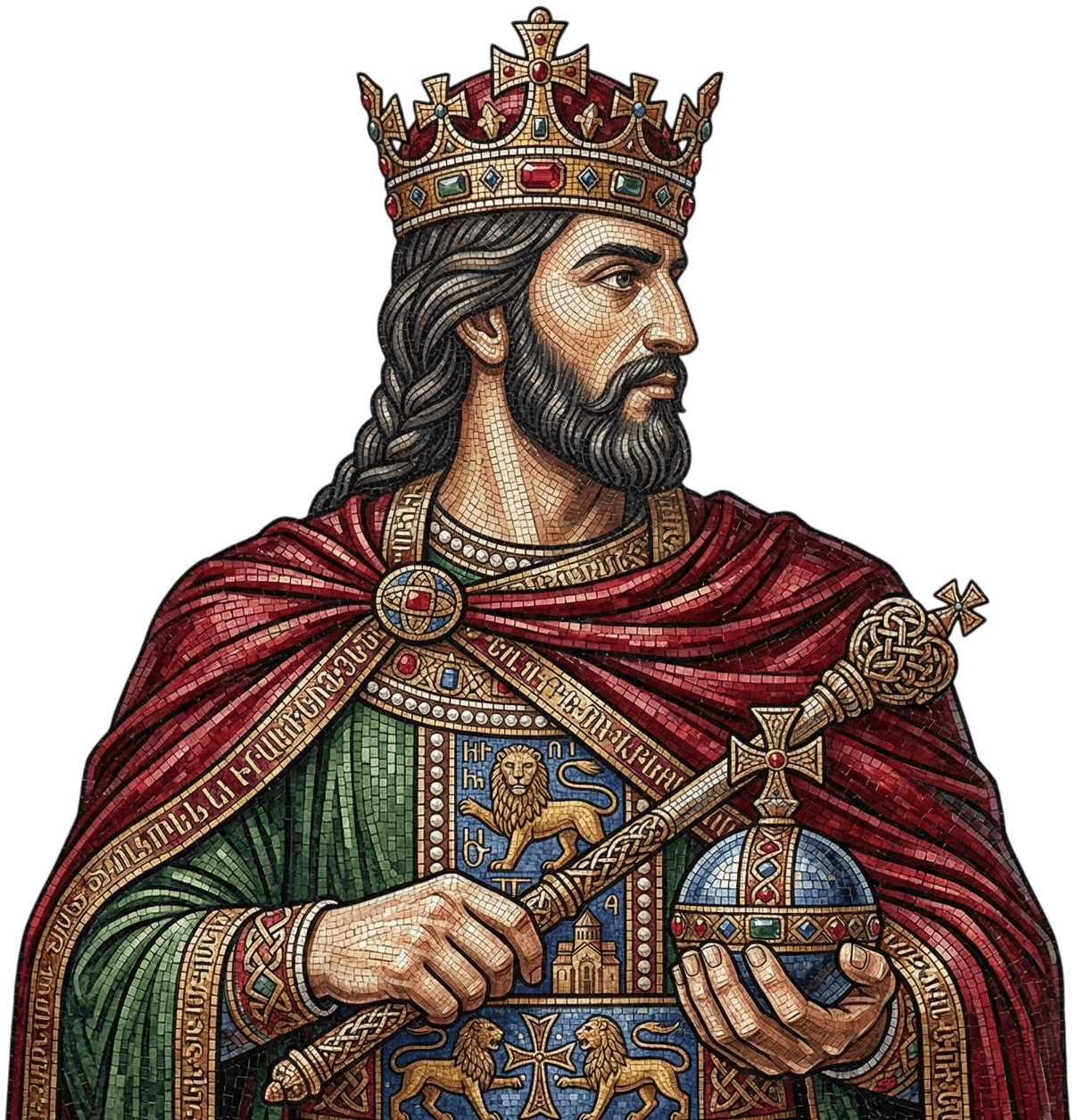
Mleh
Prince
Rubenid Dynasty — 1170–1175 AD
Armenian Kingdom of Cilicia
Mleh reigned from 1170 to 1175 as the eighth Lord of Cilician Armenia (Kilikia). A son of Leo I and a relative of the Crusader Kings of Jerusalem, he emerged from a long period of exile in Edessa and service in the court of Nur ad-Din in Aleppo. He successfully reclaimed his ancestral domains by leveraging a powerful Turkish army, eventually displacing the regency of his nephew, Ruben II, and establishing a centralized and sovereign administration. His reign was characterized by a pragmatic and controversial departure from traditional Armenian alliances. By forging a military pact with the Muslim Emir Nur ad-Din, Mleh successfully expelled Byzantine and Frankish forces from the highlands, reclaiming the major cities of Adana, Msis, and Tarsus. In 1173, he made the strategic decision to name Sis as the new capital of the Armenian state. Despite his successes in strengthening the military and economy, his internal centralization efforts led to a noble conspiracy that resulted in his assassination in 1175.
Mleh reigned between 1170 and 1175, following a life defined by the turbulent shifts of power in the Levant. After escaping the Byzantine invasion of 1137 that claimed his father and brothers, he found refuge with his cousin, Joscelin II of Edessa. His career took a distinctive turn when he entered the service of the Emir of Aleppo, Nur ad-Din ibn Zangi, where he became a key organizer of campaigns against the Frankish crusaders. This period of his life was marked by a deep immersion in Eastern military strategy, and while some chronicles claim he converted to Islam during this time, his later actions—including the construction of the Medzkar Monastery and his marriage to the sister of Catholicos Gregory—suggest his primary motivations were political and pragmatic rather than religious.
The Consolidation of Power and the New Capital
Upon the death of his brother Thoros II in 1169, Mleh returned to Cilician Armenia (Kilikia) to challenge the regency of the child-king Ruben II. Although he initially swore an oath to share the country, he soon seized absolute control, leading his nephew’s supporters to flee to Hromgla. As the sole ruler, Mleh implemented a policy of strict centralization, expelling rebellious nobles and limiting the Church's interference in state affairs. He achieved what his predecessors could not: the total liberation of Plains Cilicia (Dashitayin Kilikia) from Greek and Frankish presence. To solidify his rule over these reclaimed territories, he designated the city of Sis—strategically located between the mountains and the plains—as the permanent capital of the Armenian state in 1173.
Diplomatic Shift and Tragic Succession
The hallmark of Mleh’s tenure was his revolutionary foreign policy. By aligning with the Muslim powers of the Near East, he secured the borders of the Armenian Highlands against Byzantine aggression, allowing for a period of internal prosperity and the minting of new Armenian currency. However, his harsh internal measures and his alliance with non-Christian states created deep-seated resentment among the Armenian elite and clergy. In 1175, during the fifth year of his reign, Mleh was murdered in the capital of Sis by a group of his close associates, led by the eunuchs Aplgharip and Djahan. He was buried in the monastery of Medzkar, leaving the throne to his nephew, Ruben III, who would eventually execute his assassins to restore the honor of the Rubenid house.
Royal Record
Family & Notes
Sibling: Toros II. Notes: Usurped the throne with Muslim support; converted to or allied with Islam; eventually murdered by his own nobles.
Wars & Battles
3 Wars: 1. Usurpation; 2. Wars against Crusaders; 3. Internal noble revolt.
War Record
1 Won / 0 Lost (Internal end)
Territory Size
c. 70,000 km2km^2km2
Allied Rulers
Nur ad-Din Zangi
“The legacy of Mleh Prince endures through the centuries — a testament to the enduring spirit of the Armenian people and their unbroken pursuit of sovereignty, culture, and faith.”
Continue the Journey