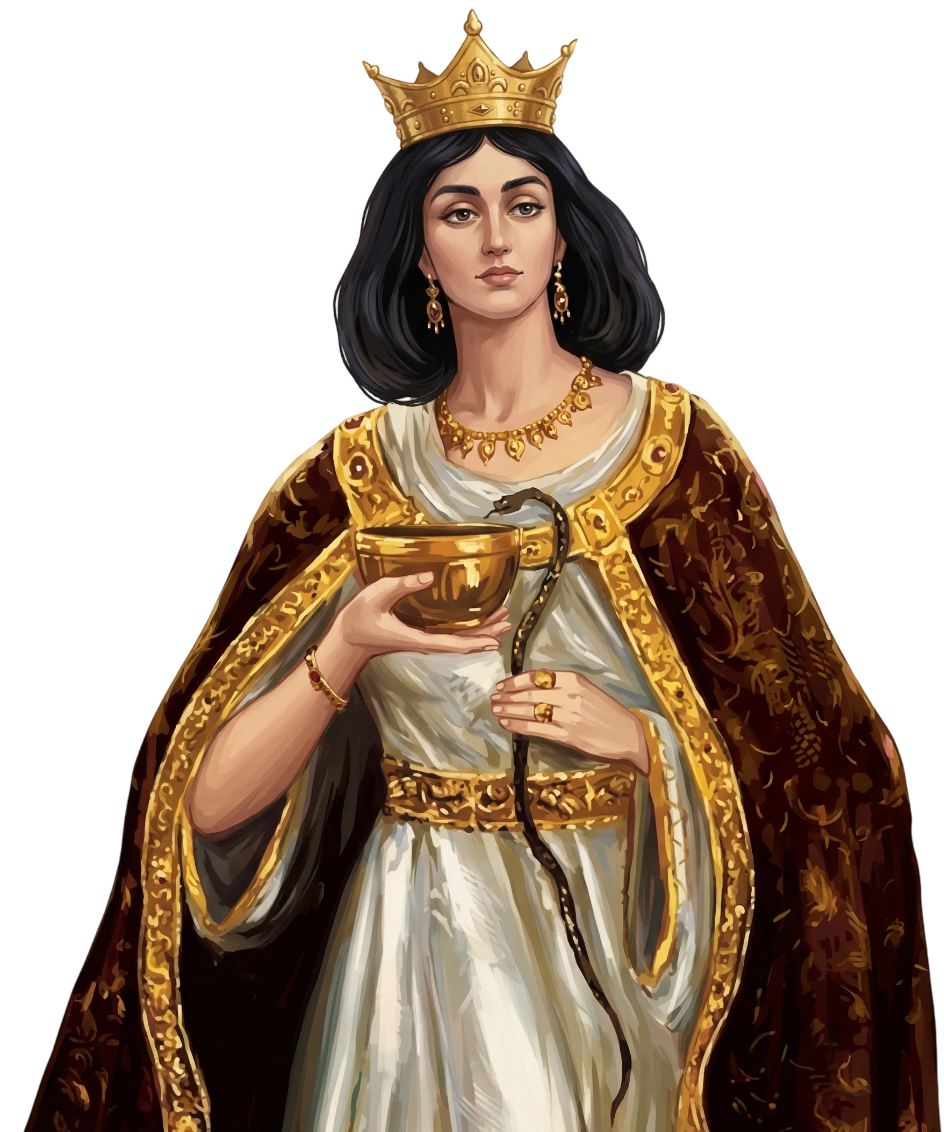
Zabel I & Hethum I
Queen & King
Hethumid Dynasty — 1226–1270 AD
Armenian Kingdom of Cilicia
Zabel I, also known as Isabella, reigned from 1219 to 1252 AD as the queen regnant of Cilician Armenia (Kilikia) and the final representative of the Rubenid (Rubinyan) dynasty. Born in Sis to King Leo I and Sibylla of Cyprus, she was designated as the royal heir by her father and ascended the throne while still a child under the successive regencies of Adam of Baghras (Atan) and Constantine of Baberon (Constantine Lambronatsi). Her reign was defined by pivotal dynastic marriages intended to stabilize the Armenian state. After her first marriage to Philip of Antioch ended in his imprisonment and death due to his disregard for Armenian customs, she was married to Hethum I in 1226 AD, uniting the Rubenid and Hethumid houses. Queen Zabel was highly skilled in science and learning, and she is remembered for her extensive patronage of the arts and healthcare, including the founding of a hospital in the capital in 1241 AD.
Zabel I reigned between 1219 and 1252 AD, taking the throne during a period of significant dynastic transition. Following the death of her father, the powerful King Leo I, the Armenian Highlands of the south faced a succession crisis as Raymond-Roupen attempted to seize the crown. With the support of the Armenian nobility, the pretender was defeated and executed, and Zabel was proclaimed queen under the protection of the regent Adam of Baghras. Following Adam's assassination, Constantine of Baberon assumed guardianship of the young monarch, navigating the intense political pressures of the Kingdom of Cilicia (Kilikia) to preserve the royal bloodline.
The Struggle with the House of Antioch
To settle ongoing disputes over the throne, the Armenian princes arranged for Zabel to marry Philip of Antioch in 1222 AD. However, this union proved disastrous; Philip’s "Latinophile" policies and offensive behavior deeply alienated the Armenian court. He went so far as to despoil the royal palace and attempt to send the Armenian crown to Antioch. In response, Constantine of Baberon had the young prince imprisoned in Sis and later poisoned. To secure the future of the state, Constantine then orchestrated a marriage between Zabel and his own thirteen-year-old son, Hethum, in 1226 AD. This union was eventually formalized by Rome in 1237 AD, marking the transition of the Armenian monarchy to the Hethumid (Hetumyan) line.
Patronage and the Works of Mercy
Beyond her role in the dynastic shift, Zabel I was a highly educated sovereign who actively contributed to the kingdom's development. She shared a degree of royal power with her husband, co-signing official deeds such as the transfer of the strategic castle of Haronie to the Knights of the Teutonic Order. In 1238 AD, the royal couple worked together to rebuild the Andul Monastery, and Zabel personally sponsored the construction of the Cathedral and the Church of St. Marine in Sis. Her commitment to the welfare of her subjects was most clearly demonstrated in 1241 AD, when she founded a dedicated hospital in the capital. Upon her death on January 23, 1252 AD, she was buried in the Monastery of Trazarg (Drazark), leaving a legacy of faith and architectural beauty.
Royal Record
Family & Notes
Husband: Hethum I (r. 1226-1270). Notes: Hethum I traveled to Mongolia to meet the Great Khan (1254), securing a vital Mongol alliance.
Wars & Battles
11 Conflicts: 1. Regency Wars; 2. Mongol alliance (1247); 3. Battle of Ain Jalut (1260); 4. Battle of Sis; 5. Siege of Aleppo (1260).
War Record
5 Won, 3 Lost, 3 Draw
Territory Size
c. 80,000–100,000 km2km^2km2
Allied Rulers
Möngke Khan, Louis IX (France)
“The legacy of Zabel I & Hethum I Queen & King endures through the centuries — a testament to the enduring spirit of the Armenian people and their unbroken pursuit of sovereignty, culture, and faith.”
Continue the Journey