Khosrov I
Arsacid Dynasty — 191-217 AD
Arsacid Dynasty
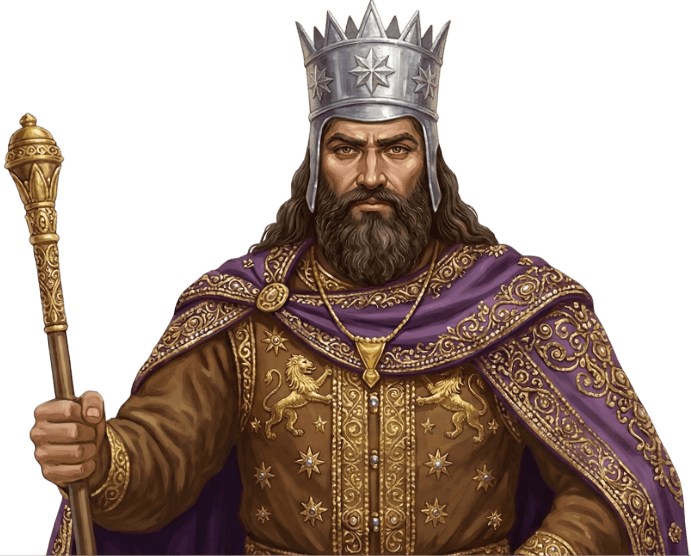
Khosrov I, celebrated in Armenian tradition as Khosrov the Brave (Khosrov Kadj), reigned from 191 to 217 AD as a prominent monarch of the Arshakuni (Arsacid) dynasty in Armina (Greater Armenia). The son of Vologases II, he ascended the throne when his father became the King of Kings of Parthia, establishing a reign characterized by high diplomatic standing and immense military reorganization. Initially maintaining a policy of strategic neutrality toward Rome, Khosrov I sent gifts to Septimius Severus but was later detained by Emperor Caracalla, an act that triggered a major Armenian uprising. He is historically noted for establishing Armenian suzerainty over the northern tribes and leading a decades-long struggle to preserve the Arsacid legacy against the rising Sasanian Empire.
Khosrov I reigned between 191 and 217 AD, though extended accounts of his military activity against the Sasanians suggest his influence continued as a leader of the Arsacid resistance until 253 AD. Early in his reign, he demonstrated extraordinary military talent by leading a force of 110,000 soldiers across the Caucasus Mountains. At the Battle of the Derbend Pass in 207 AD, he crushed the combined armies of the Alans and Basils, forcing the northern kingdoms to accept Armenian suzerainty. By securing hostages from the Sarmatians and Khazars and placing his brother Rev on the Iberian throne, Khosrov I created a powerful confederation of northern states under the central authority of the Kingdom of Armina (Greater Armenia).
Diplomatic Tensions and the Battle of Nisibis
The relationship between Khosrov I and the Roman Empire was complex and volatile. While he traveled to Egypt as an ally of Septimius Severus in 202 AD, he was later lured into a trap and detained by Emperor Caracalla in 216 AD. This betrayal sparked a massive retaliatory campaign led by the Armenian Prince Tiridates, whose forces defeated the Roman legions and pushed them back to Edessa. In the aftermath of Caracalla's assassination, the new Emperor Macrinus was forced to release Khosrov I and his queen in 217 AD to secure a peace treaty. This period solidified Khosrov's reputation as a monarch who could command respect and extract concessions from the greatest powers of the West.
The War for the Arsacids and the Final Betrayal
Following the fall of the Parthian Empire to the Sasanians in 224 AD, Khosrov I initiated the "War for the Arsacids," a conflict that lasted nearly three decades. Seeking to restore his kin to the Iranian throne, he invaded Atropatene and Mesopotamia, at one point defeating Ardashir I under the walls of Ctesiphon. Unable to stop the Armenian king on the battlefield, the Sasanian King Shapur I resorted to a political conspiracy. In 253 AD, a nobleman named Anak of the Suren clan entered the Armenian court under the guise of an ally and murdered the king. Although the assassin was executed, the death of Khosrov I marked the end of Armenian hegemony over the surrounding regions and left the throne to his brother, Khosrov II.
Royal Record
Family & Notes
Child: Tiridates III (The Great). Notes: Fiercely resisted the Sassanids; was assassinated by Anak the Parthian (father of Gregory the Illuminator).
Wars & Battles
4 Wars: 1. Resistance to Shapur I; 2. Valerian's campaign; 3. Border skirmishes; 4. Sassanid plot.
War Record
2 Won, 1 Lost, 1 Draw
Territory Size
c. 350,000 km2km^2km2
Allied Rulers
Claudius II (Rome)
“The legacy of Khosrov I endures through the centuries — a testament to the enduring spirit of the Armenian people and their unbroken pursuit of sovereignty, culture, and faith.”
Continue the Journey