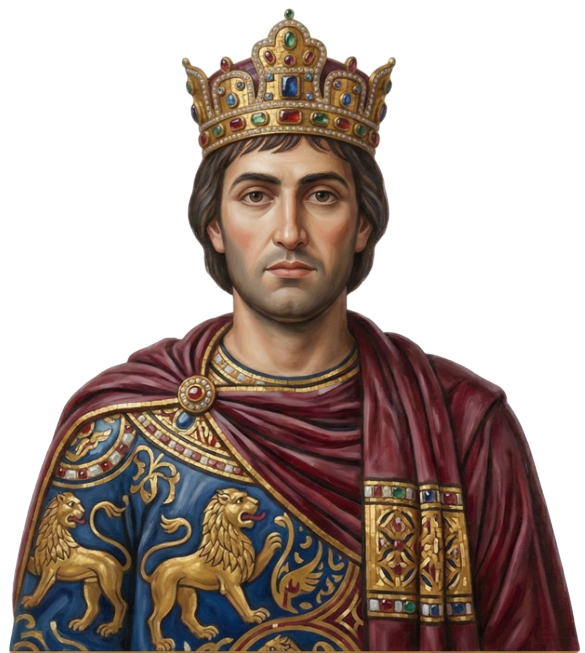
Leo III
Hethumid Dynasty — 1301-1307 AD
Armenian Kingdom of Cilicia
Leo IV reigned from 1320 to 1341 AD as the final Hethumid monarch of the Kingdom of Cilicia (Kilikia). Succeeding his father, Oshin I, at the age of ten, he spent his minority under the regency of his uncle, Oshin of Korikos. His reign was defined by persistent harassment from the Mamluk Sultanate and a violent internal consolidation in 1329 AD, during which he ordered the execution of his regent, his wife Alice, and the Constable Constantine to secure his sole authority. Governing from the capital of Sis, Leo IV pursued a controversial pro-Western policy, seeking a union between the Armenian and Roman Churches to attract European military aid. This stance deeply alienated the native Armenian barons and failed to prevent the loss of the strategic port of Ayas to the Egyptians in 1337 AD. Left isolated by a humiliating treaty and waiting for aid that never arrived, he was eventually murdered by his own nobles in 1341 AD, marking the end of the Hethumid dynasty.
Leo IV reigned between 1320 and 1341 AD, assuming the throne during a period of extreme vulnerability for the Kingdom of Cilicia (Kilikia). His early years were dominated by the regent Oshin of Korikos, who forced the young king into a marriage with his daughter, Alice, while systematically eliminating rivals within the royal family. Upon reaching his majority in 1329 AD, Leo IV responded with a ruthless purge to reclaim his sovereignty. He ordered the murder of Oshin, his wife Alice, and the Lord of Lampron, sending the regent’s severed head to the Mongol Il-Khan as a sign of his absolute power. This violent transition allowed him to seize the estates of the fallen lords, which he subsequently granted to Latin officials in a desperate attempt to foster closer ties with the West.
The Western Policy and Religious Friction
The central theme of Leo IV’s administration was a staunchly pro-Western and "Latinophile" orientation. Believing that the survival of the Armenian Highlands of the south depended on a European crusade, he advocated for the unification of the Armenian and Roman Churches. This religious pivot, further emphasized by his 1331 AD marriage to Constance of Sicily, exacerbated the conflict between the "Unitarian" and "Anti-Unitarian" factions within his realm. Despite diplomatic efforts by Pope John XXII to incite Mongol intervention on behalf of the Armenians, the promised Western aid never materialized. Instead, his policy only served to fracture the internal unity of the kingdom and weaken the resolve of the native nobility.
The Fall of the Hethumids
The final years of Leo IV’s rule were marked by territorial retreat and strategic isolation. In 1337 AD, the Mamluk Sultan Naser Mohammed invaded again, capturing the vital harbor of Ayas. Leo was forced to conclude a humiliating truce that ceded significant southeastern territories and prohibited the kingdom from further dealings with Western powers. Strategically paralyzed, the king spent his remaining years confined within the citadel of Sis, hoping for a maritime relief force that never appeared. On August 28, 1341 AD, the deep-seated resentment of the Armenian barons culminated in his assassination. With the death of his only son, Hethum, years earlier, his murder brought a definitive end to the Hethumid royal line, and the throne was passed to his cousin, Constantine II of the House of Lusignan.
“The legacy of Leo III endures through the centuries — a testament to the enduring spirit of the Armenian people and their unbroken pursuit of sovereignty, culture, and faith.”
Continue the Journey