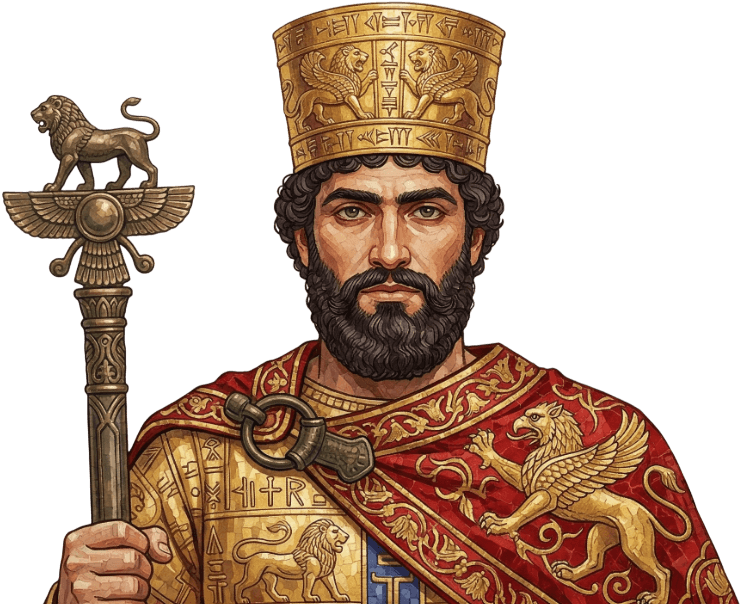
Sarduri II
Araratian Dynasty — 764–735 BC
Kingdom of Urartu
Sarduri II reigned from 764 to 735 BC as the King of the Kingdom of Ararat (Urartu), succeeding his father, Argishti I. Under his rule, the kingdom reached the peak of its territorial expansion, with borders stretching from Kulkhai (Colchis) and the Kur River in the north to Northern Mesopotamia and the Euphrates in the west. Sarduri II is noted for his significant military reforms and for achieving a decisive victory over the Assyrian King Ashur-nerari V in 753 BC, which allowed him to establish dominance over Melitea (Melid) and Kummuh (Commagene). His extensive military and political achievements are recorded in a massive chronicle found on the northern slope of the Van Rock in 1916. While he initially sought to completely encircle Assyria by reaching both the Mediterranean and Babylon, his momentum was challenged by the rise of Tiglath-pileser III. After a major defeat in 743 BC at the Battle of Arpad, Sarduri II shifted his focus toward securing the northern and eastern frontiers, including the Sevan basin and Pulua-di (Iranian Azerbaijan). He left behind a legacy of architectural strength, including the fortification of Kayalıdere and the massive walls of Tushpa (Van).
Sarduri II reigned between 764 and 735 BC, inheriting a powerful state from his father, Argishti I. At the start of his reign, he faced a complex internal situation, including a rebellion by several provincial governors against the central authority. He crushed these uprisings with great severity and implemented military reforms to strengthen his armed forces. With a consolidated domestic front, Sarduri II embarked on a grand strategic plan to encircle the Assyrian Empire. He successfully pushed his influence into Northern Syria (Aram) and Northern Mesopotamia, forcing kingdoms such as Mana and Kummuh (Commagene) to pay him tribute. By 753 BC, he had defeated the Assyrian King Ashur-nerari V, effectively displacing Assyrian dominance in the region for a decade.
Conquests of the North and East
The military reach of Sarduri II was unprecedented in the history of the Kingdom of Ararat (Urartu). He remains the only monarch known to have reached Kulkhai (Colchis) on the Black Sea coast twice. In the north, he completely subjugated the Etiuni tribal confederacy and expanded into Abiliania (upper Araks) and the Sevan basin, entering the region from a western route through the Eriahini country. His inscriptions detail the massive scale of these campaigns; for instance, a single campaign into Eriahini resulted in the capture of 21,989 people—6,436 men and 15,553 women—along with thousands of horses, camels, and cattle. By securing these fertile agricultural and pastoral lands, he ensured the long-term economic stability of the empire.
The Struggle with Tiglath-pileser III
The latter half of Sarduri II’s reign was defined by the resurgence of Assyria under the reformer Tiglath-pileser III. To counter this rising threat, Sarduri II organized a powerful coalition of western states. However, in 743 BC, at a decisive battle in Arpad (Kummuh), the Urartian forces and their allies suffered a major defeat. While Sarduri II was forced to retreat and took shelter within the impregnable walls of Tushpa (Van), the Assyrians were unable to capture the capital itself. Following this turning point, Sarduri II abandoned his southern territorial ambitions and spent his remaining years strengthening his grip on the northern territories and the Arasbaran (Karay-dagh) region. His reign remains one of the most documented eras of ancient Armenian history, preserved through hundreds of lines of cuneiform on the Van Rock.
Royal Record
Family & Notes
Father: Argishti I. Wife: Susaratu. Son: Rusa I. Suffered severe defeats against Neo-Assyrians. Defeats by Tiglath-Pileser III.
Wars & Battles
1 recorded war (Tiglath-Pileser III).
War Record
0 Won, 1 Lost.
Territory Size
Minor losses ~350,000 km²
“The legacy of Sarduri II endures through the centuries — a testament to the enduring spirit of the Armenian people and their unbroken pursuit of sovereignty, culture, and faith.”
Continue the Journey