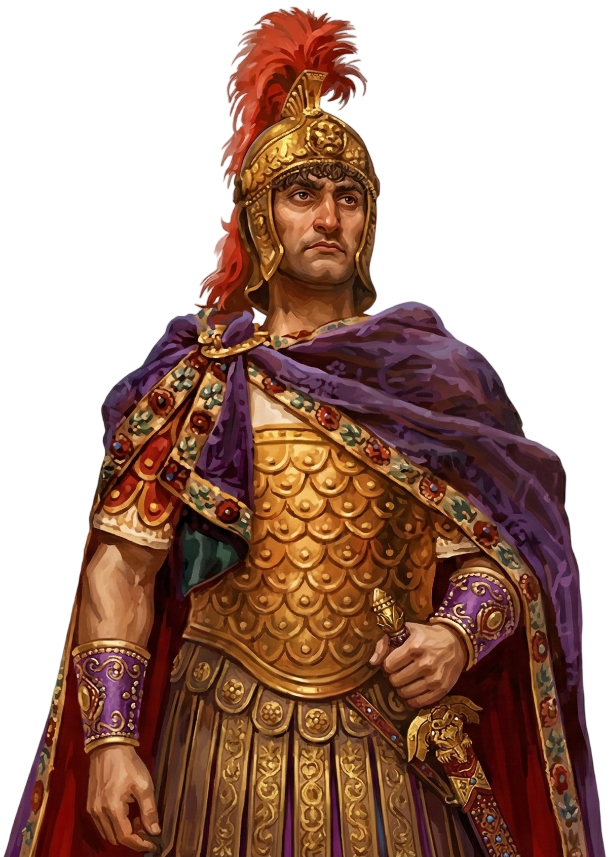
Tigranes III
Roman Client King
Artaxiad Dynasty — 20–8 BC
Artaxiad Dynasty
Tigranes III reigned from 20 to 8 BC as the monarch of the Kingdom of Armina (Greater Armenia), succeeding his brother, Artaxias II. After being captured by Mark Antony and spending ten years in Roman exile and education, he was installed on the Armenian throne by Tiberius following a palace conspiracy in Artaxata. His early reign brought a period of peace and stability between Rome and the highlands. Despite being positioned as a Roman client-king, Tigranes III eventually asserted an independent foreign policy around 10 BC, distancing himself from Roman influence. His later coinage, minted in an Eastern style with Parthian influences, reflects this shift toward sovereign authority. He left the kingdom to his son, Tigranes IV, and his daughter, Erato.
Tigranes III reigned between 20 and 8 BC, emerging from a background of long-standing political captivity. Captured as a young prince by Mark Antony in 34 BC, he was initially taken to Alexandria before being moved to Rome after Octavian’s invasion of Egypt. During a decade of political exile, he received a high Roman education, eventually becoming Augustus's preferred candidate to replace the anti-Roman Artaxias II. In 20 BC, at the request of the Armenian nobility who had lost faith in his brother, Augustus dispatched Tiberius with a large army to install Tigranes III. Before the legions even reached the capital, Artaxias II was assassinated by a palace cabal, allowing Tigranes III to be crowned in Artaxata (Artashat) without opposition.
The Shift Toward Sovereignty
Although his ascension was hailed in Rome as a major diplomatic victory, Tigranes III proved not to be a submissive tool of the empire. While his initial years were marked by peaceful relations and stability, he gradually shifted his orientation toward the East. By 10 BC, he had notably moved away from his Roman education and begun pursuing an independent political course. This transformation is immortalized in his unique coinage, which abandoned traditional Artaxiad patterns in favor of a "Parthian style." On these coins, Tigranes III is depicted with a short beard and Eastern attire, standing at full height with a long scepter—a powerful numismatic symbol of his reclaimed royal autonomy.
Stability and the Succession
Throughout his twelve-year reign, Tigranes III successfully maintained the borders of the Armenian Highlands, ensuring a rare period of internal peace. Although Rome attempted to weaken the kingdom by detaching Media Atropatene and placing a client-king there, Tigranes III preserved the core of the Artaxiad realm. Upon his death in 8 BC, he was succeeded by his son, Tigranes IV, and his daughter, Erato, from two different mothers. His reign serves as a significant historical bridge, demonstrating the ability of an Artaxiad prince to navigate Roman patronage while ultimately returning to the traditional Eastern roots of the highland monarchy.
Royal Record
Family & Notes
Children: Tigranes IV, Erato. Notes: Installed by the future Emperor Tiberius; his reign represented the start of deep Roman interference in Armenian succession.
Wars & Battles
1 Campaign: Installation by Rome (no major independent wars).
Territory Size
c. 350,000 km2km^2km2
Allied Rulers
Augustus Caesar
“The legacy of Tigranes III Roman Client King endures through the centuries — a testament to the enduring spirit of the Armenian people and their unbroken pursuit of sovereignty, culture, and faith.”
Continue the Journey